
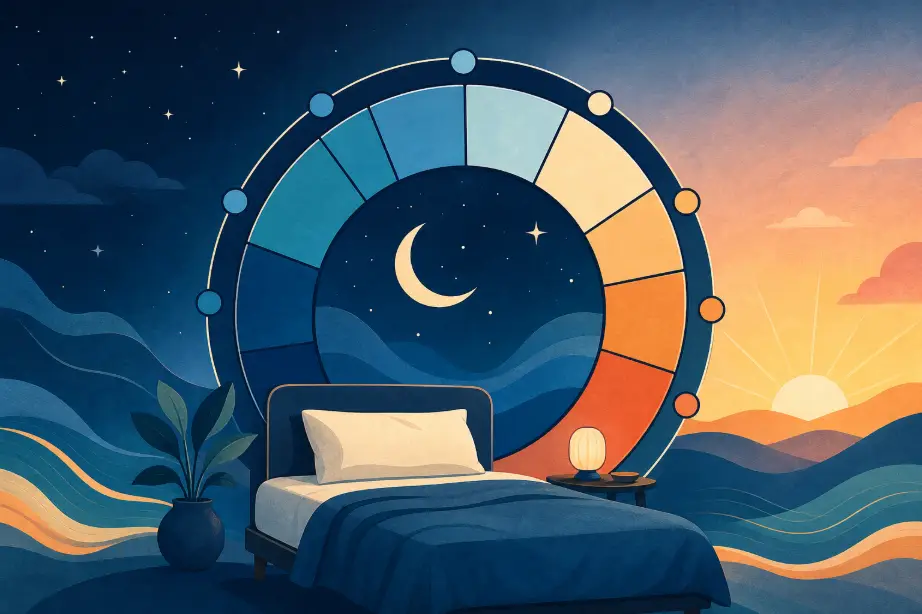
Smart Sleep Calculator: Beyond the 90-Minute Cycle, Customizing Your High-Efficiency Rest Plan
Have you ever hopefully used a "90-minute sleep cycle calculator," set your alarm, only to wake up feeling even groggier? Or have you found that those precise minute-by-minute bedtime suggestions are impossible to follow in the face of busy work, unexpected overtime, or childcare demands? The problem lies not in the sleep cycle theory itself, but in the fact that traditional calculation methods are oversimplified, ignoring individual differences, circadian rhythms, and real-life circumstances. This article combines the latest sleep science to provide you with a highly personalized, actionable guide to optimizing your sleep cycles.
Why the Traditional "90-Minute Sleep Calculator" Doesn't Work for You
The Scientific Truth of Sleep Cycles: More Than Simple 90-Minute Arithmetic
Sleep is not a uniform state of rest but a cycle composed of multiple "REM" (Rapid Eye Movement) and "Non-REM" stages. A complete cycle typically lasts about 90 minutes, but this is merely a population average.
- Individual Differences: Studies show that an adult's sleep cycle length can fluctuate between 80 and 120 minutes. This means that by rigidly applying the 90-minute rule, you might be forcibly awakened by an alarm during a deep sleep stage, leading to severe "sleep inertia" (that groggy feeling upon waking). Furthermore, your "sleep latency" (the time it takes from lying down to actually falling asleep) varies from person to person—ranging from 5 to 30 minutes or more—and is often ignored in traditional calculations.
- Age Stratification: Sleep needs change drastically with age. Newborns need 14-17 hours of sleep daily, with a cycle structure different from adults. The elderly experience reduced deep sleep and more frequent nighttime awakenings, making a simple cycle count less meaningful. Therefore, sleep management strategies for children, adults, and the elderly should be significantly different.
Core Factors Ignored by Traditional Calculators: Circadian Rhythms and Light Exposure
Your sleep-wake cycle is driven by a powerful internal biological clock—the circadian rhythm—which is primarily regulated by light.
- Melatonin Secretion and Your Optimal Sleep Window: As night falls, the pineal gland in the brain begins to secrete melatonin, promoting sleepiness. Morning light (especially blue light) suppresses melatonin secretion, making you alert. Everyone's melatonin secretion curve is different, which determines your natural "sleep window." Ignoring this window and forcing sleep at the wrong time naturally yields poor results.
- Are You a "Night Owl" or a "Lark"? This is determined by your "chronotype." Forcing a "night owl" to sleep at 10 PM is no different than forcing a "lark" to stay up until 2 AM; both lead to difficulty falling asleep. Identifying and aligning with your physiological clock is the first step to optimizing sleep.
The "Accurate Calculation, Impossible Execution" Dilemma: The Conflict Between Real Life and Ideal Sleep
Even if you calculate the perfect bedtime and wake-up time, sudden overtime, social events, or waking up to care for a baby can disrupt the plan. Traditional rigid calculators lack flexible adjustment strategies to cope with these realistic challenges, leading users to eventually give up.
The Core of a Customized Solution: Your Exclusive "Smart Sleep Cycle Calculator"
To break the deadlock, you need a dynamic, personalized calculation framework rather than a fixed formula.
Step 1: Accurately Assess Your "Sleep Latency" and "Actual Cycle Length"
This is the cornerstone of personalized calculation.
- Self-Observation and Sleep Log Method: For one week, record the time you turn off the lights to sleep and the time you actually feel you fell asleep. The difference is your average sleep latency. Also, on rest days without an alarm (like weekends), observe your natural wake-up time. Work backward to calculate total sleep time and divide by the number of cycles you feel you completed to roughly estimate your personal cycle length.
- Leverage Smart Wearable Data: If you use a sleep monitoring device, focus on "sleep onset" and "sleep stage" data. The cycle length estimated by the device via heart rate and body movement can serve as an important reference. For example, observe how long it typically takes you to enter the first deep sleep stage after falling asleep, and the regularity of each stage's duration.
Step 2: Find Your Optimal "Sleep Window" Based on Circadian Rhythms
- Light Management: This is the most powerful tool for regulating your biological clock. Get exposure to outdoor sunlight or bright light as soon as possible after waking up (for at least 30 minutes) to effectively reset your biological clock, making you feel sleepy earlier at night. Conversely, avoid blue light from phones and computers one hour before bed; use blue-light-blocking glasses or enable night mode on devices.
- The Importance of Consistency and the Flexibility Principle: Try to wake up at the same time (including weekends); this stabilizes the biological clock more than a fixed bedtime. For bedtime, set a flexible window of about 1 hour (e.g., aim to fall asleep between 23:00-00:00) to handle daily fluctuations and reduce anxiety.
Step 3: Practical Cycle Optimization in Diverse Scenarios
- "Mini-Cycles" and "Compensatory Sleep" for Shift Workers: For night shift workers who cannot get a full long sleep, strategically schedule 90-120 minutes of "core sleep" to focus on obtaining the most critical deep sleep. Then, supplement with 1-2 short naps of about 20 minutes during the day (avoiding deep sleep to prevent inertia). This is more effective than fragmented long shallow sleep.
- "Time Zone Reversal" Strategy for Travel: Before departure, try to gradually adjust your schedule. Upon arrival, immediately schedule meals and light exposure according to the destination time. If flying East (time advances), get more morning sunlight; if flying West (time delays), get more afternoon sunlight. On the plane, use an eye mask and earplugs to strive for a complete 90-minute cycle of rest.
- Efficient Napping: A short nap of about 20 minutes can quickly restore alertness without causing sleep inertia. If time permits and deep repair is needed, you can schedule a full 90-minute cycle, but allow for a 15-30 minute "buffer time" to fully wake up afterward.
Saying Goodbye to Sleep Anxiety: Shifting Mindset from "Perfect Cycles" to "Quality Sleep"
Pursuing a perfect cycle can itself become a source of stress, paradoxically affecting sleep.
Understanding Sleep Inertia: The True Meaning of Waking Up at the End of a Cycle
We aim to wake up at the end of a sleep cycle (usually light sleep or REM sleep) to minimize sleep inertia, not to eliminate it completely. Occasionally being woken from deep sleep is normal and nothing to be anxious about. The key is optimizing long-term trends.
Fragmented Sleep Data Integration: How to Use Device Data for Personalized Corrections
Don't just stare at the "Sleep Score." Look at trends: Is your average sleep latency shortening? Is the proportion of deep sleep stable? Are nighttime awakenings decreasing? Combine this data with your subjective feelings (morning alertness, daytime energy) to dynamically adjust your "personal calculation parameters." For instance, if data shows your cycle length has been close to 100 minutes for several days, base your next calculation on 100 minutes.
Practical Sleep Hygiene Advice: More Than Just "Less Phone Time"
- Diet: Avoid being too full or too hungry before bed, and avoid caffeine and alcohol.
- Exercise: Regular exercise helps improve sleep, but avoid vigorous exercise within 3 hours of bedtime.
- Environment: Ensure the bedroom is dark, quiet, and cool. Consider using blackout curtains or a white noise machine.
- Stress Management: Engage in relaxing activities one hour before bed, such as reading, meditation, or a warm bath, to establish a "shutdown ritual."
Frequently Asked Questions (FAQ)
How many cycles do I actually need per night to be sufficient?
Most adults need 4 to 6 complete sleep cycles, i.e., 6-9 hours. However, the core indicator is your daytime functional state. If you remain awake and energetic for most of the day without strong drowsiness, your number of cycles is sufficient. You don't need to be rigid about sleeping exactly 5 or 6 cycles.
What if I can't wake up at the end of a cycle?
This is very common. First, ensure your alarm setting accounts for your personal sleep latency (e.g., if you want to wake at 7:00, cycle is 90 mins, and latency is 20 mins, try to sleep around 23:10). Second, use a smart alarm or place it where you must get up to turn it off. Most importantly, stick to a fixed wake-up time. Even if you haven't slept enough, get up and get light exposure. This strengthens your biological clock, helping you naturally wake up at the right time in the long run.
Can a sleep calculator replace professional medical advice?
Absolutely not. The strategies provided in this article are for healthy individuals looking to optimize sleep. If you suffer from chronic insomnia, extreme daytime sleepiness, sleep apnea (e.g., severe snoring, pauses in breathing), or other sleep disorders, please consult a doctor or sleep specialist. A sleep calculator is a self-management tool, not a means of medical diagnosis or treatment.